
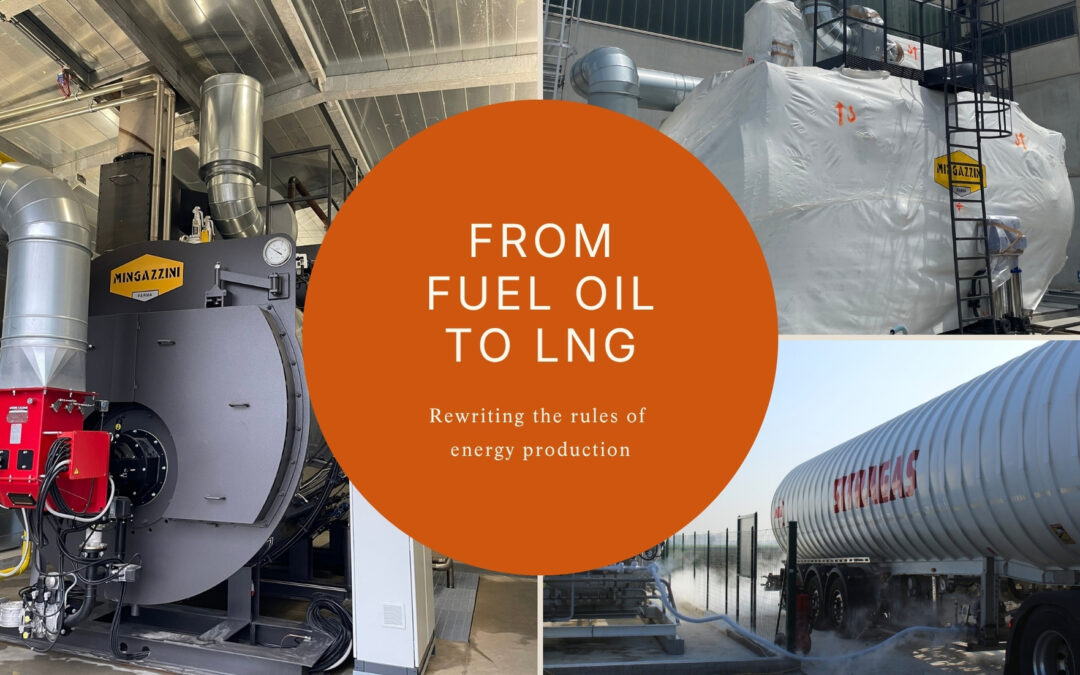
This is the story of a complex construction site, courageous decisions and a significant, coordinated effort.
Cutting CO₂ emissions from thermal energy by a third, eliminating interference between production systems, and building a plant capable of regulating itself in real time: these are the tangible results Artoni e Fadani achieved with the completion of its LNG installation at the end of 2025. It is a journey that we undertook with excellent partners, changing the technology and the way in which the plant produces and manages the heat needed to process poplar panels.
On their path towards environmental sustainability, Artoni and Fadani had already installed a 855 kWp photovoltaic system in 2022, capable of halving CO₂ emissions from electricity (equivalent to a reduction of 250 tonnes per year). Continuing to power production with high-impact fossil fuels was inconsistent with the company’s chosen direction.
Of the options available, LNG (liquefied natural gas) was the obvious choice: compared to mains methane, it offers a higher energy yield and paves the way for the future use of BioLNG, a 100% renewable fuel with an even lower environmental impact. For consultancy, installation of the storage facility and supply management, we turned to Vulcan, a leading LNG and BioLNG distributor.
The starting point: one generator, three systems
Alongside our long-term vision of achieving energy sustainability, the old system had some basic technical issues. A single heat generator supplied energy to both the presses and the dryer without a control system to balance their respective demands.
It was similar to having three flats to heat with a single communal boiler and three tenants arguing over how to manage it: some wanted hotter water, some wanted colder water and some were happy with the way it was. Making the situation even more delicate was the fact that, over the years, production capacity and energy demand had grown, while the old generator had gradually become less efficient.
An intelligent system
When it comes to changing the energy infrastructure of a production plant, the most obvious temptation is to replace what isn’t working with something more powerful. However, our goal was not just to increase energy availability, but also to transform the way energy is produced, distributed and controlled.
We chose two partners with complementary skills. Mingazzini, a long-standing manufacturer of industrial boilers based in Parma, designed and built the generator — the heart of the new system — while Gierre Caldaie, a well-established company specialising in the installation of steam generators and heating systems, designed and built the heat distribution system.
Thanks to these two collaborations, the “intelligent system for the production and distribution of heat for presses and dryers” was born.
The result is an unprecedented level of performance. The generator produces abundant quantities of steam and superheated water at constant pressure, ensuring consistent quality. The distribution system can therefore draw on either fluid under consistently stable conditions, and the temperature control on the individual systems achieves an unprecedented level of precision in our factory.
All data is collected and processed by the MES system, which was developed and customised in collaboration with AP Srl, specialists in smart factory technologies. This means that the key parameters of the plywood production process are always under control and we can accurately quantify the energy consumption of each plant. This is valuable data for environmental monitoring and industrial accounting.
Results in numbers and daily practice
The energy system no longer operates in isolation. In practice, this means less waste and fewer fluctuations, as well as the ability to intervene in advance in the event of any deviations from the parameters.
In terms of the environment, switching to LNG combined with the new generation system enables us to reduce CO₂ emissions from thermal energy by a third, with an estimated decrease of 650 tonnes per year. Combined with the reductions already achieved through photovoltaics, Artoni e Fadani has cut its overall CO₂ emissions by almost 900 tonnes per year compared to the starting point.
“In recent years, we have invested heavily in technology and environmental sustainability,” explains Rosa Manuela Artoni, the company’s director. “Our vision is of a future that respects those who work with us and the space around us. Our partners have supported us with great professionalism and expertise from the outset, especially in making the most complex decisions.”
With the path already paved towards BioLNG, the future will be thermal production using entirely renewable fuel. In the meantime, the data collected by the system daily will continue to guide us.
Project milestones
In 2025 we completed the LNG storage facility and the boiler room.
Watch the video for the key moments.
Follow our social channels from February to discover our new feature on shared time. We look forward to seeing you there.